The high-quality city centre that Bratislava deserves – the final part of the first major phase of the Živé námestie (“Living Square”) project is complete
02. 10. 2026
6 minutes read
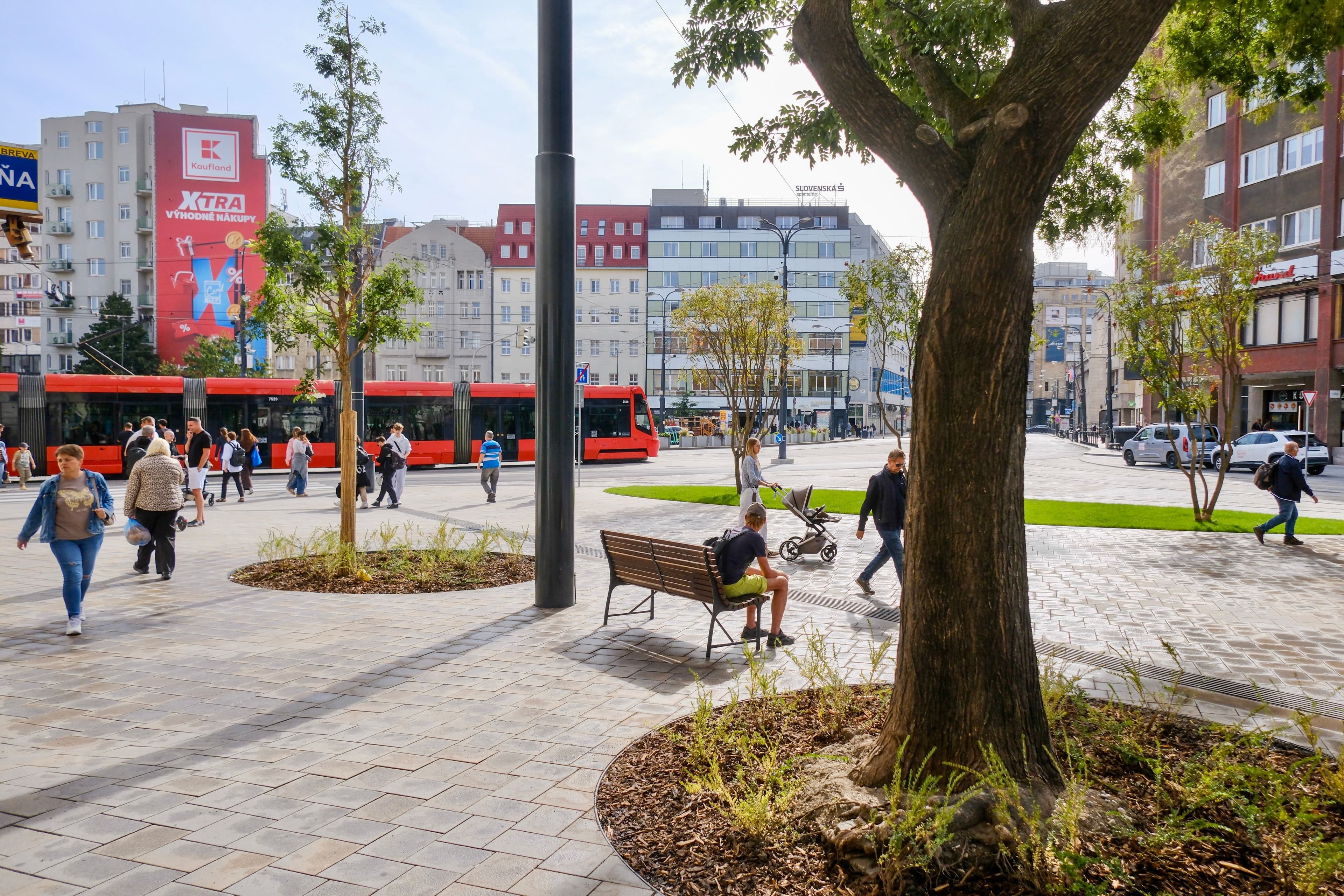
Bratislava, 2 October 2026 – Bratislava Mayor Matúš Vallo today symbolically opened a revitalised and fully reconstructed public space in the heart of the city, comprising Námestie SNP, Námestie Nežnej revolúcie and Poštová ulica. This major project of renewal of a truly extensive area, known as Živé námestie (“Living Square”), was a collaborative effort involving the Metropolitan Institute of Bratislava (MIB), with an architectural design by the renowned German studio LOIDL. It has transformed this central area, giving it a modern look worthy of a 21st-century European capital.
Said Matúš Vallo, mayor of the capital city:
“I am truly delighted that we are returning this important public space to Bratislava – in a more pleasant, beautiful, accessible and greener form. The renovation project has not only unified the public space; it has eliminated unnecessary barriers. We replaced the original concrete and asphalt surfaces with granite paving stones, which are of higher quality and more attractive, while also being better suited in terms of climate change adaptation. New greenery and street furnishings have also been added. Bratislava deserves high-quality public spaces, and I am incredibly happy that the city’s heart has now gained this new level of quality."
The major reconstruction of the area was preceded by initiatives from the Aliancie Stará tržnica (Old Market Hall Alliance) and subsequent rapid urban improvements – so-called “quick wins” – which saw the planting of new trees on Klobučnícka ulica and the expansion of areas on Námestie SNP that allow pedestrians easier and safer passage. An international architectural competition followed and resulted in a winning design by the renowned studio Atelier LOIDL, in collaboration with traffic engineers from BPR. The design brought barrier-free accessibility, incorporated blue-green solutions to mitigate the negative impacts of climate change, took a sensitive approach to the history of surrounding buildings, and, above all, unified the squares in the heart of Bratislava while preserving the distinct character of each of them.
After months of meticulous preparation, which included geological, engineering and heritage surveys, the selection of a contractor and the transformation of the architectural concept into a high-quality construction plan, the reconstruction work began in October of last year.
The result is the complete revitalisation of an area covering 16,401 m². The transformation at first focused on the southern section of Poštová ulica and the central part of Námestie SNP; then, Námestie Nežnej revolúcie and the area between Špitálska ulica and Treskoňova ulica were also redeveloped.
Great emphasis was placed on greenery throughout the renovation process. A total of 37 new trees were planted in the area, incorporating root cells, supplemented with under-tree plantings, and a new green island was created at the corner of Špitálska ulica and Námestie SNP.
Modern water-retention systems were installed beneath Námestie Nežnej revolúcie and Námestie SNP, the upper and middle sections of which, along with the lower part of Poštová ulica, had already been completed in the summer to capture rainwater. This water will not only cease placing an unnecessary burden on the municipal sewerage network but will also be used to irrigate the greenery.
The asphalt and multicoloured surfaces in the area have been replaced with high-quality granite paving. On Námestie SNP, the city expanded the space for pedestrians, narrowed the asphalt roadway, added cycling infrastructure and installed new lighting. New pedestrian paths and lighting were also introduced, making the SNP Memorial a dominant feature of the area. During the reconstruction, the memorial to Ján Kuciak and Martina Kušnírová was integrated into the new paving in such a way to ensure it serves as a truly dignified site of remembrance.
The city also honoured the history that forms an essential part of Bratislava on Námestie Nežnej revolúcie. A special type of paving has been laid here that outlines the footprint of the Church of St. Lawrence, which once stood on the site. This feature appears even more strikingly after rain: water remains slightly longer in the grooves of the paving, thus creating a glistening outline of the ground plan of the former church. The roofing of the Chapel of St. James, located on the square, was also revitalised. The original glazing was replaced with safety glass; the plasterwork was restored, and new electrical wiring, lighting, and stainless-steel elements were installed to make access to the ossuary easier and safer. The work, including archaeological surveys, will continue to pave the way for the future construction of a new pavilion corresponding to the site's significance and including all necessary features: barrier-free access, a visitor route and an exhibition space.
The Lion Fountain on Námestie Nežnej revolúcie has been restored, and new street furnishings have been installed, including the popular benches encircling the trees.
The tram tracks and platforms serving Line 1 at Námestie SNP have also undergone complete reconstruction and repaving. The asphalt here has been replaced with high-quality granite paving, and the tram corridor itself has been paved. The use of “Kassel curbs”, which feature a raised boarding edge, were used to make getting on and off the trams more comfortable and safer at these locations. Modern shelters, tactile paving strips for the blind and visually impaired, stop markers, ticket machines and new street furnishings (such as trash cans and benches) have also been added. Electronic information displays will also soon be installed. The entire area has been expanded and made much more comfortable and pleasant; it also now offers barrier-free connections to the surrounding area.
In cooperation with Dopravný podnik Bratislava (Bratislava Transport Company), the busy stop on Špitálska ulica, where passengers had long been forced to board and alight directly on the roadway amidst traffic, has also been upgraded. The previously unused track area has been turned into a fully functional boarding platform – specifically, an island platform raised above the roadway – to facilitate easier, barrier-free boarding and alighting. The entire stop area features high-quality stone paving, with modern shelters and street furnishings (such as trash cans, benches, and a stop marker) added. The improvements here have made movement through the area more comfortable and, above all, safer. The new stop serves tram lines 3 (to Petržalka) and 4 (to Dúbravka).
Final work is currently underway on Treskoňova ulica, where paving, curbing and the installation of street furnishings are being completed. The project is expected to be completed by mid-October.
The Živé námestie reconstruction project, co-financed by the European Union under the Slovakia Programme, is definitively transforming the heart of Bratislava into a higher-quality, more pleasant and cohesive public space. The city’s efforts do not stop there, however. In the future, the city plans to gradually transform Kamenné námestie from a chaotic transit zone into a place for relaxation, community interaction and cultural life, the kind of space Bratislava’s city centre truly deserves.